A dealer in a hot coastal market takes delivery of four used six-tonne excavators. The paint is fresh, the hour meters read between 6,200 and 7,400, and the machines start cleanly on the quay. Six weeks later one is weeping from a water pump, a second is pushing bubbles into its expansion tank under load, and a third has a heater core that will not warm the cab. Nobody photographs the expansion tank during a handover, and yet it is the cheapest inspection item on the machine: a translucent bottle of liquid that records how the unit was actually run. A coolant system keeps a maintenance log in physical form. Every top-up leaves a tide line, every overdue change leaves chemistry behind, every overheating event leaves its mark on the cap and the crust pattern around the necks. The hour meter tells you how hard a machine worked; the coolant tells you how carefully it was looked after, and whether the seller's story matches it. This guide is written for importers and dealers buying used machines by the unit or by the container, and for the workshops that commission them on arrival. It sets out what coolant can prove, gives the reading order and the numerical thresholds to write onto a handover sheet, shows the signature that a season of plain-water top-ups leaves behind, and closes with the sample-retention routine that decides who pays when a claim starts three weeks after the risk has transferred.
Coolant is the cheapest lie detector on a used machine
Used equipment is sold on hours, undercarriage, hydraulics and appearance, in roughly that order. Coolant rarely appears on the inspection sheet at all, which is strange, because it is the one fluid that interacts with every hot metal surface in the engine and the one that leaves readable evidence of neglect. A machine that has been run on the correct long-life coolant at the right concentration will show a clean reservoir wall, a bright fluid, an intact cap seal and no crust at the hose necks. A machine that has been topped up with well water and had its coolant changed once in five years will show a tide line, a brown tint, a swollen hose and a pump that is already on its way out. Both machines can wear the same paint. Only one of them will cost you a workshop bill inside the first quarter. The comparison below is the reason this inspection belongs before payment and not after arrival: the inspection costs a refractometer and two sample bottles, and the failures it catches cost several orders of magnitude more.
| Failure | What the handover check would have shown | Indicative cost band (USD) |
|---|---|---|
| Water pump seal failure | Damp or white crust at the weep hole, glitter or grit in the reservoir, swollen hose at the pump neck | 120 to 450 in parts and labour |
| Radiator core replacement | Hard scale or sludge on the header tank wall, a crust ring at the cap seat, a history of climbing temperature | 400 to 1,600 depending on core size and availability |
| Oil cooler or heat exchanger leak | Oil sheen, grey film or emulsion in the reservoir with the level otherwise normal | 350 to 1,200 plus two flushes and a re-test |
| Heater matrix blockage | Brown sludge, low inhibitor reserve, visible particulate in the drawn sample | 150 to 600 plus dashboard labour on some models |
| Wet liner pitting in a heavy diesel | No nitrite program, a history of plain-water top-ups, freeze point well above design | Engine overhaul territory, typically 3,000 and upwards |
| Head gasket or cracked head | Milky emulsion, continuous bubbling at the filler neck, falling level with no external leak | 800 to 4,000 depending on the engine |
Read the level cold, then read the crust
Level means nothing until the engine is cold and the machine is level. Coolant expands by roughly four to seven per cent between ambient and operating temperature depending on concentration, so a system filled to MAX cold will sit at MAX hot and a system filled to MAX hot will be low once it cools. Ask for the machine to be presented cold, or come back later; a seller who cannot arrange a cold engine is showing you something in itself. On a cold, level machine the correct reading sits between MIN and MAX on the translucent tank. A level at or below MIN is not a cosmetic detail. The loop is sealed and pressurised, so a cold system that has lost fluid is either leaking externally, leaking internally, or has been pushing fluid out through a weak cap. Whatever the cause, the pump has been moving a mixture that includes air, and air is what pits impellers and creates hot spots on the way to a boil-over. The opposite finding deserves equal suspicion: a reservoir filled to the brim on a cold engine usually means somebody topped up a system they knew was losing fluid, and did it shortly before the sale.
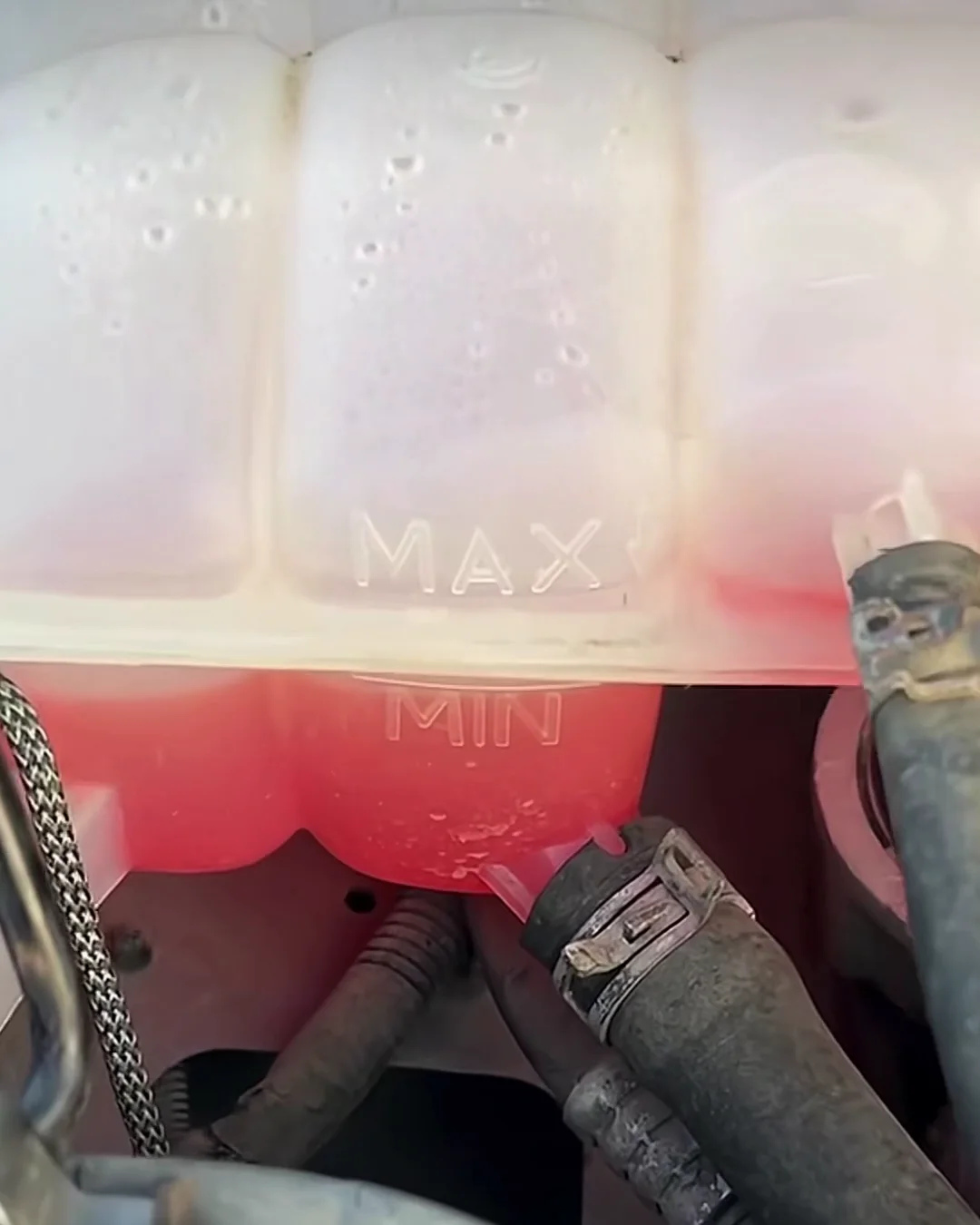
The dried residue around the tank and the necks is the second half of the reading, and it is more reliable than the seller's memory. Coolant that escapes a joint does not usually drip; it evaporates and leaves the dye and the inorganic salts behind as powder or crystal. Learn four patterns and you can date the problem. A ring of powder at the MAX line means chronic overfill and a system that has been venting through the cap on every heat cycle. Crust concentrated at a hose neck or a thermostat housing means a slow seep that has been drying for months, and a clamp that has already lost tension. Deposit confined to the underside of the cap seal means the cap has been acting as the pressure relief, either because the spring is weak or because the system has genuinely boiled. A white tide line on the inside wall of the reservoir is the signature of hard water: every top-up left calcium and magnesium behind, and the same water has been depositing scale on the hottest surfaces in the engine.
| Where the deposit sits | What it usually means | Action before payment |
|---|---|---|
| Powder ring at the MAX line | Chronic overfill; fluid has been venting past the cap on heat cycles | Pressure test or replace the cap, confirm the correct rating, and check for exhaust gas in the coolant |
| Crust at a hose neck or thermostat housing | Slow seep that dries before it drips; clamp tension already lost | Price a hose and clamp set, and re-check after 500 hours of service |
| Deposit on the cap seal only | Light film is normal; heavy crust points to boiling or a weak spring | Test the cap on a pressure gauge and replace if it does not hold its rating |
| White tide line inside the reservoir | Hard-water top-ups; scale is forming on hot surfaces | Full flush, refill with deionised water and the correct grade |
| Nothing at all, spotless tank | Either genuine maintenance or a cosmetic flush before sale | Look for new clamps, fresh sealant and clean block paint before believing the first explanation |
Four fluid states, four different decisions
Colour is a condition indicator, not a specification. Two coolants built on entirely different inhibitor chemistries can share the same dye, and the colour code that many buyers rely on is a marketing convention rather than a standard. What colour does tell you reliably is what has happened inside the loop: whether iron is corroding, whether oil has crossed into the water circuit, whether the inhibitor package has been consumed. Read it in a clear bottle against white paper in daylight, not through the wall of a dirty tank, and photograph it — a photograph taken at handover ends most arguments later.
| In a clear bottle | Most likely cause | Decision at handover |
|---|---|---|
| Bright, translucent, the colour the specification expects | Inhibitors present and the system has been maintained | Verify freeze point and inhibitor reserve, then accept |
| Brown, rusty or tea-coloured but still clear | Iron corrosion; the inhibitor package is depleted | Full flush and refill; inspect the water pump and the radiator core |
| Milky, creamy or opaque | Oil or transmission fluid has entered through a cooler | Diagnose the cooler before any coolant decision; this is a mechanical fault, not a fluid fault |
| Black with suspended grit or fibre | Hose inner wall breaking down, or pump and gasket material in suspension | Open the system and expect hose replacement alongside the flush |
| Colourless, faintly tinted, or with a rust film on the surface | Repeated plain-water top-ups | Treat as unmaintained; price a flush, a fill and likely seal work |
Plain-water top-ups leave a signature you can price
The single most common finding on used machines from hot markets is not a wrong coolant; it is water. An operator loses two litres to a weeping hose, buys a bottle of drinking water at a roadside shop, and repeats it every month because the temperature gauge looks fine afterwards. In a tropical site nothing freezes, so the mistake is invisible until it is expensive. Each top-up dilutes the glycol, and glycol does two jobs: it lowers the freeze point and it raises the boiling point. Dilution therefore gives away boiling margin exactly when the ambient temperature is highest, and it thins the inhibitor package at the same time. Run the arithmetic on a twelve-litre system filled at fifty per cent and topped up with three litres of water over a season: the concentration falls to roughly forty per cent, the freeze point moves from about minus 37 to about minus 24, the boiling margin loses several degrees, and the corrosion inhibitors sit at three quarters of their design strength. Nothing about the machine feels different until a hot afternoon, a long climb, or a corroded pump bearing turns the arithmetic into a repair order.
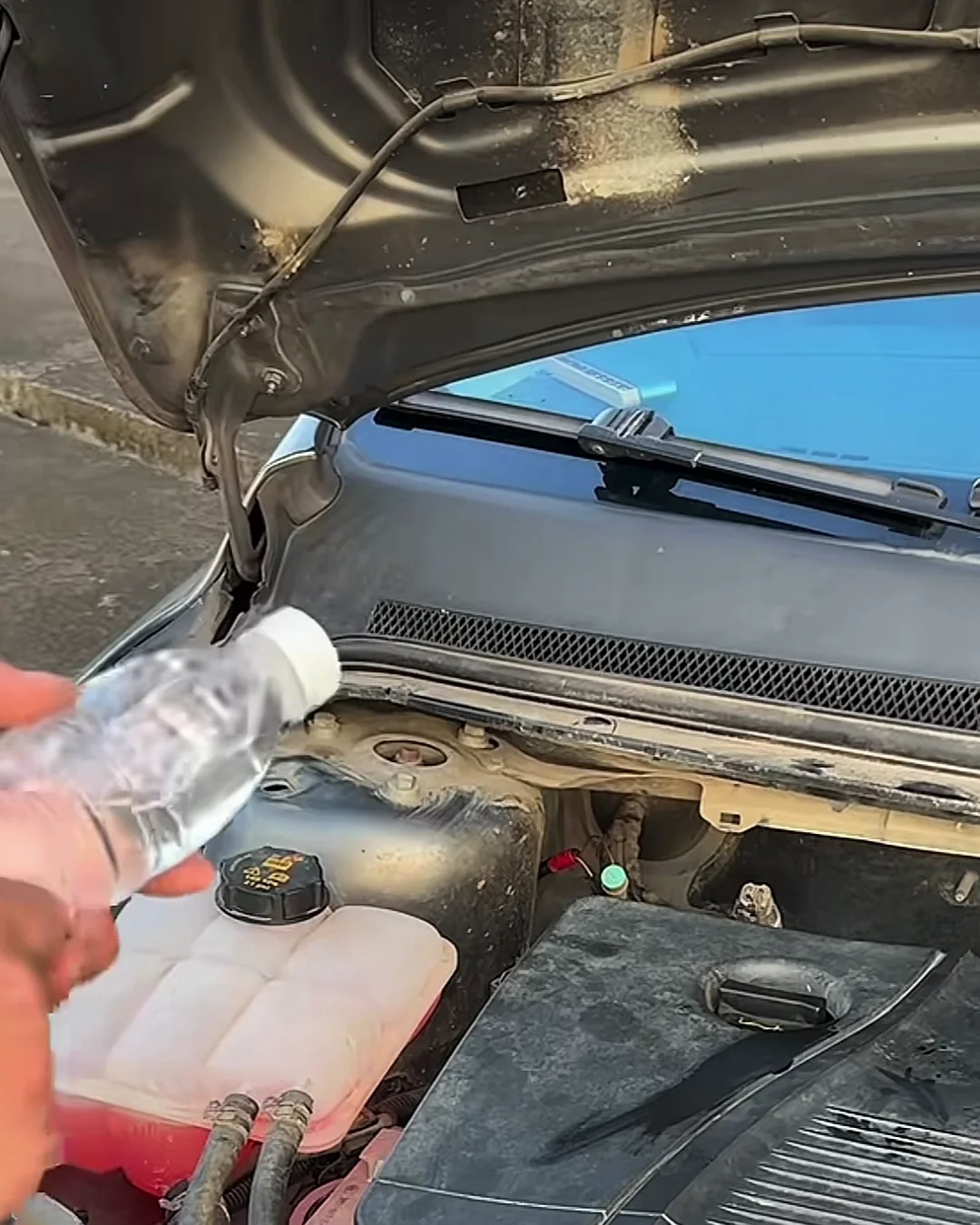
Water carries more than dilution. Depending on its source it brings calcium and magnesium, which precipitate as scale on the hottest surfaces, and chloride, which drives pitting on aluminium and on solder. A machine run for years on well water can have a perfectly normal freeze point after a fresh top-up and a cooling system that is already coated. This is why the visual inspection and the refractometer have to be done together: the number can look acceptable on the day of handover while the history is written on the tank wall.
The refractometer number is the only hard evidence you can take in ten minutes
A handheld optical refractometer costs less than a set of filters and fits in a jacket pocket. Calibrate it with distilled water to the zero line in front of the seller, draw a few drops from the cold reservoir with a clean pipette, close the plate, and read against daylight. Record the number and the ambient temperature, not the word normal. The instrument measures refractive index and converts it to a glycol percentage or a freeze point; different scales exist for ethylene glycol, propylene glycol and battery acid, so confirm which scale you are reading before you write anything down. On a used heavy diesel, also record whether a strip test for nitrite was taken, because nitrite is the additive that protects wet cylinder liners and it is invisible to a refractometer.
| Measured freeze point | Implied glycol concentration | Interpretation at handover |
|---|---|---|
| Minus 45 °C or lower | about 55 to 60 per cent | Full-strength cold-climate fill. Confirm it is not above 60 per cent, which raises the freeze point again and cuts heat transfer |
| Minus 35 to minus 40 °C | about 48 to 52 per cent | Design concentration for a minus 35 °C product; correct if that is what the machine specifies |
| Minus 22 to minus 28 °C | about 38 to 42 per cent | Partly diluted. Acceptable in tropical service only if the inhibitor reserve is verified separately |
| Minus 12 to minus 18 °C | about 30 to 35 per cent | Diluted. Boiling margin and corrosion protection are both below design; renegotiate |
| 0 to minus 5 °C | under 15 per cent | Effectively water. The system has no usable protection and the history is unknown |
Wet liner pitting: the question nobody asks at handover
Heavy diesels and many industrial engines use wet cylinder liners, where the liner wall is in direct contact with coolant on one side and combustion on the other. The liner vibrates microscopically with every power stroke, and those vibrations collapse vapour bubbles against the outer wall until the metal erodes into pits that eventually break through. A correctly specified heavy-duty coolant prevents this with a dedicated additive package; a light-duty coolant, or water, does not. Nitrite, where the specification calls for it, is typically maintained in a band of several hundred to a few thousand parts per million depending on the product and the engine maker, and it is consumed in service, which is why fleets test it. At handover the pitting itself is invisible without a teardown, so the check is documentary: ask for the coolant product name and the last two service invoices, ask whether the fleet tested nitrite, and look at the reservoir for the brown or black film that accompanies advanced liner corrosion. If the answer is silence, budget for a full flush, a heavy-duty fill and a nitrite record from day one, and let the price carry that risk.
Four red flags that belong in the price, not the calendar
- Fresh coolant in a machine with an untouched, oily engine bay and no service record. Cosmetic servicing before a sale is common, and it hides both a leak and a history.
- New hose clamps, fresh silicone around a thermostat housing or tool marks on the water pump bolts on a machine with original hoses everywhere else.
- A radiator or water pump that looks newer than the rest of the engine bay while the hour meter says eight thousand hours.
- A reservoir with no sediment line at all on a high-hour machine, which is not how a working cooling system ages.
- A seller who will not allow a cold-level check, a refractometer reading or a 200 ml sample to be drawn. The refusal is the finding.
The fifteen-minute handover sequence
Run the same order every time, on every unit, and record it on a sheet the seller signs. Consistency is what makes the record usable if a dispute starts later.
- 1Photograph the hour meter, the machine plate and the whole engine bay before touching anything.
- 2Confirm the engine is cold to the touch at the top tank, and that the machine stands level. If it is warm, stop and come back.
- 3Write the ambient temperature and the hour reading onto the handover sheet.
- 4Read the level against MIN and MAX, and photograph the tank with a scale or a ruler in the frame.
- 5Remove the cap and inspect the underside: seal hardness, crust ring, free play in the spring.
- 6Wipe the inside wall of the reservoir with a white cloth and look at what comes off.
- 7Draw 200 ml into a clean clear bottle, hold it against white paper in daylight, and photograph it.
- 8Read the freeze point with a calibrated refractometer and record the number and the scale used.
- 9If a strip test is available, record pH and nitrite; if not, write not tested rather than assuming.
- 10Check both hose necks and the clamps for softness, swelling and crust, and look at the pump weep hole for damp or powder.
- 11Sign and date the sheet with the seller or the surveyor present, and attach the photographs to the invoice file.
Take a sample: the arbitration file
A photograph proves what the fluid looked like; a retained sample proves what it was. Both are cheap, and together they are the difference between a conversation and a claim. The routine below takes two minutes and should be written into the purchase order as a condition of the balance payment, which also has the useful side effect of telling you how the seller reacts to scrutiny.
- 200 ml in a clean, dry bottle, filled from the cold reservoir, not from the drain.
- Label it with the machine serial number, the hour reading, the date, the ambient temperature and the name of whoever drew it.
- Photograph the bottle next to the machine plate in a single frame so the sample can never be separated from the unit.
- Have the seller and, where one is engaged, the surveyor sign the label or a photograph of it.
- Keep it for at least ninety days after arrival, out of sunlight, and re-test freeze point and pH if a dispute begins.
Pass, service or renegotiate
The findings only matter if they change a decision. Use one rule for all of them: anything that is going to require opening the cooling system is priced before the unit is paid for, and anything that cannot be inspected is priced as if it had failed.
| Finding | Decision | Commercial action |
|---|---|---|
| Level between MIN and MAX, bright fluid, freeze point within 5 °C of design, no crust | Pass | Record the reading, commission the machine, no price adjustment |
| Level at or below MIN with clear fluid and a correct freeze point, no external leak found | Service before dispatch | Pressure test, top up with the correct grade, re-check the level after twenty minutes of running |
| Brown or diluted fluid, freeze point 10 °C or more above design | Renegotiate | Deduct a full flush, a correct fill, a water pump inspection and one hose set |
| Milky fluid, oil sheen, or a falling level with no external leak | Walk away, or price an engine repair | Deduct cooler diagnosis plus the worst case, or reject the unit entirely |
| Fresh coolant over a dirty engine bay, no records and new clamps | Renegotiate | Assume an unresolved leak and deduct a cooling system rebuild allowance |
| Any reading you were not allowed to take | Treat as unmaintained | Price the full service as though the system had been run dry |
Refilling the machine properly for its new climate
A used machine often changes climate twice: it leaves a temperate or cold production site and goes to work where the ambient temperature never drops below twenty degrees. In that service the freeze point is over-specified and harmless, but the numbers that matter shift. Boiling margin becomes the limiting figure, because a hot day at full load raises metal temperatures far more than a cold start ever lowers them; inhibitor reserve becomes the limiting figure for the pump, the radiator and the liner walls. Over-concentrating to be safe is a common and expensive mistake: beyond about sixty per cent glycol the freeze point starts to rise again, heat transfer falls, the pump works harder and the fluid viscosity increases. For coolant supplied by BOLITCH the measured boiling points by grade are 101 °C for the 0 °C grade, 109 °C for the minus 35 °C grade and 110 °C for the minus 45 °C grade, which is a band of 101–110 °C across the range, and the long-life products are specified for five years or 300,000 km in normal duty at the correct concentration.
- Flush until the drain runs clear. Use a chemical flush only where scale or sludge is present, and neutralise it properly before refilling.
- Fill with the grade matched to the coldest recorded ambient at the destination site, mixed with deionised or distilled water if you are using a concentrate.
- Verify the concentration with a refractometer after twenty minutes of running and a full cool-down, not at the moment of filling.
- Keep one chemistry family per machine. Organic acid, hybrid and conventional packages do not combine into a better product.
- Replace the cap if the seal has hardened or the spring is weak; a cap that releases early turns a healthy system into a boiling one.
- Label the machine with the grade, the date and the hour reading at the fill, and start a nitrite record on any wet-liner diesel.
What this means when you buy by the container
For a dealer importing six to twenty units, fifteen minutes per machine is a single afternoon of work, and it protects a margin that one missed cooler or one pitted liner can erase entirely. Write the requirement into the purchase order rather than leaving it as a courtesy: a cold-level check and photograph per unit, a refractometer reading recorded on the handover sheet, one retained sample per unit with the serial number on the label, and the coolant brand and grade with the last two service invoices where they exist. Make the balance payment conditional on receiving that file, and treat a seller who resists it as a finding in itself. None of this requires a laboratory, a certificate or a claim about the product; it requires a bottle, a torch, a refractometer and the discipline to write the number down while the machine is still cold.
Questions that come up on the quay
Can I just top up with water to get the machine home?
As a limp-home measure, clean water is better than running dry. As a habit it is the most expensive free fluid in the trade. Every litre of water displaces glycol and inhibitor, adds hardness and chloride, and lowers the boiling margin exactly when the machine is working hardest. If you have to top up in the field, use the correct ready-to-use coolant; if only water is available, record it and restore the concentration with a refractometer reading as soon as the machine reaches a workshop.
The colour matches, so is it the same coolant?
No. Colour is a dye, and dyes are chosen by marketing departments, not by chemistry. A green organic acid coolant and a green conventional coolant can be completely incompatible while looking identical, and mixing them can drop the inhibitor package out of solution or leave the system under-protected. Match the product name and the specification on the label, or the specification in the machine manual, never the colour.
The machine came from a cold country. Do I have to change the coolant for a tropical site?
Not automatically, if the concentration is inside the fifty to sixty per cent window and the inhibitor reserve is sound. What changes at the destination is the boiling margin requirement, not the freeze point, so verify the cap rating holding pressure and confirm the grade is not so concentrated that heat transfer suffers. If the machine arrives with a fluid reading warmer than minus 20 °C, it has been diluted and should be restored before it goes to work.
How do I tell whether the system is running organic acid or conventional chemistry?
From the label, the manual or the service record, and only secondarily from a strip test. The presence of nitrite, silicate or phosphate points towards a conventional or heavy-duty package; a package built on organic acids typically tests low on those and relies on different chemistry. Treat any unknown system as a candidate for a full flush and a documented refill rather than a top-up, because a partially mixed system is worse than either chemistry on its own.
Does a clean reservoir mean the coolant is fine?
It means the last person who touched the machine cleaned it, or that it was flushed shortly before the sale. A cosmetic flush looks exactly like good maintenance for the first few hundred hours. Read the freeze point, look for new clamps and fresh sealant, ask for the service invoices, and let the retained sample carry the argument if one starts later.
Request coolant grades, TDS and a batch COA
Technical data sheets (TDS) are ready to download for every coolant grade, and safety data sheets (MSDS) are available on request. Tell us your destination climate, the machine families you service, the pack sizes you resell and your monthly volume, and we will send the measured freeze-point and boiling-point data by grade, the dilution guidance for your site temperatures, the nitrite and reserve alkalinity windows we report on each batch, and a retained-sample plan for your first container. Visit bolitch.com or email sale@bolitch.com.