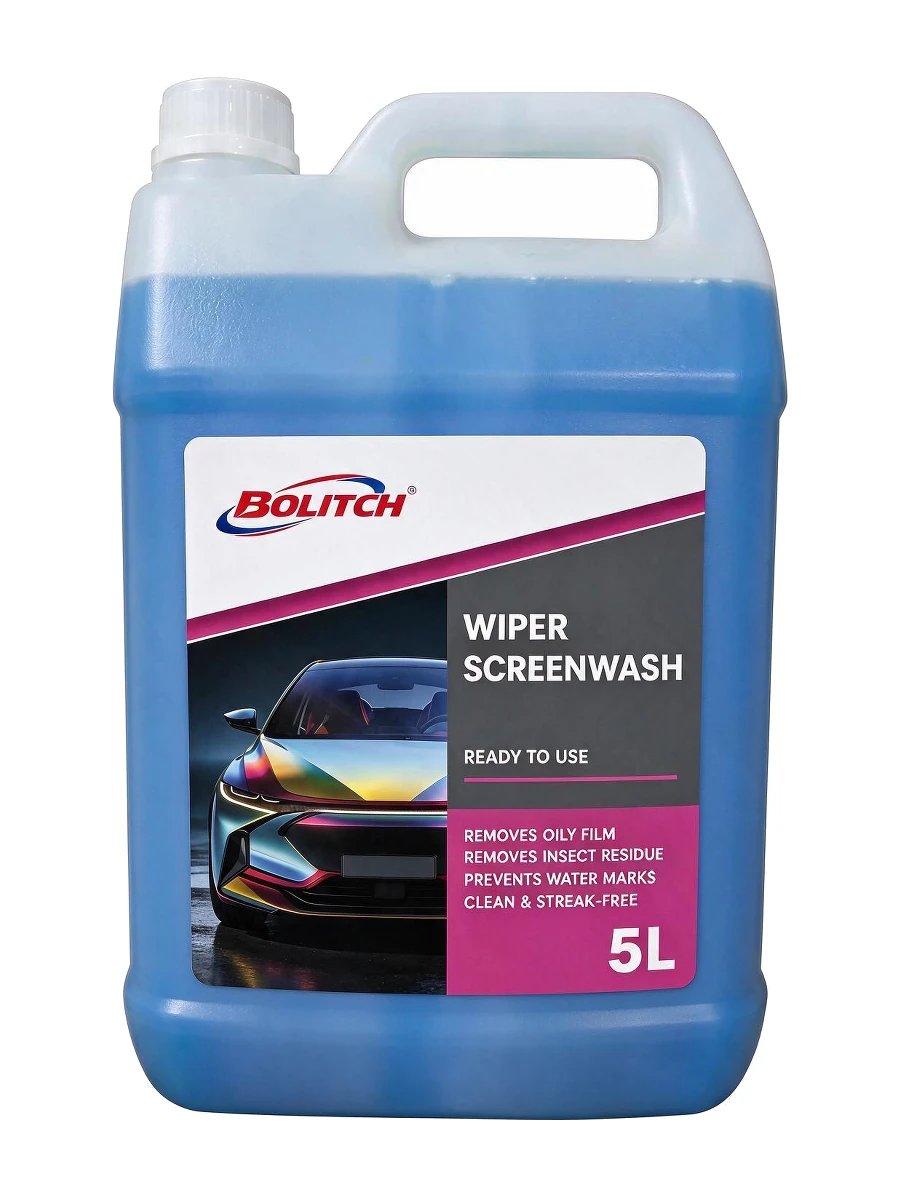
Every rainy season, the same complaint reaches the parts counter: the windshield looks smeared and hazy, the driver has just fitted new wiper blades, and the washer fluid is the first thing blamed. A distributor then faces a return, a credit note and a damaged relationship with a workshop — over a product that usually did nothing wrong. What the driver is seeing is not one fault but three, and only one of them lives in the bottle. An oily film bonded to the glass scatters light at night and in low sun; a hydrophobic coating or wax makes water bead and drag instead of sheeting off; a worn blade edge or a weak wiper arm leaves a mechanical smear that no chemistry can remove. This guide is written for importers, distributors and the workshops they supply. It separates those three faults, explains where the film comes from and why it builds faster in hot, traffic-heavy markets, gives a six-step diagnosis any counter can run in under ten minutes, and sets out what a washer fluid can honestly claim. It then moves to the part that is genuinely the supplier's responsibility: batch consistency, closure integrity and storage, with an incoming-inspection checklist, a ten-minute demonstration for dealers, the lines worth writing into a specification, and a short FAQ. None of the tests below needs a laboratory, and none of them requires you to claim a certificate you do not hold.
Haze, beading and smear: three faults that get one complaint
Ask the customer when the problem is worst. A uniform dull haze that only shows against oncoming headlights or low sun is a film on the glass. Distinct round droplets that sit on the screen and are dragged into arcs by the blade are a surface-treatment effect, often from a wash-and-wax product or a glass coating. A narrow, repeated streak in exactly the same place on every wipe is mechanical — a nick in the rubber, a bent arm, or dirt trapped under the edge. The three need completely different remedies, and treating all of them as a fluid problem is why the same bottle gets returned twice.
| What the driver reports | When it is worst | What is actually happening | Check that confirms it |
|---|---|---|---|
| A dull, grey haze across the whole screen | Night driving, oncoming headlights, low sun | A thin bonded film of oil, silicone or polymer scatters light instead of letting it pass | Wipe a small area with a clean microfibre cloth and a glass cleaner; the cleared patch is visibly sharper |
| Round water beads dragged into arcs by the blade | Light rain, just after a car wash or a coating application | A hydrophobic layer makes water stand up and travel as droplets | Spray plain water: beads that stay round point to the surface, not the fluid |
| One narrow streak in the same place on every wipe | Every wipe, wet or dry | A nicked blade edge, uneven arm pressure or grit under the lip | Lift the arm, run a fingernail along the rubber, and inspect for a notch or hard spot |
| A milky smear that appears only after spraying | Immediately after using the washer | Too little detergent for the soil load, hard-water minerals, or a product that has separated in storage | Spray onto a clean glass panel and let it dry; look for residue, then check the lot for layers or sediment |
Where the oily film comes from — and why hot markets see it sooner
The film is not one substance. It is a thin, slowly accumulating mix of whatever the vehicle drives through and whatever gets applied to the glass, baked on by sun and heat. In dense, stop-start traffic it builds far faster than on open highways, and in tropical markets high ambient temperature plus frequent rain keeps the screen in a wet-dry cycle that bakes each layer on. Diesel buses, taxis and delivery fleets are the worst case: they sit behind other vehicles all day, they are washed often, and any downtime is expensive, so a complaint that a private car would tolerate for months becomes a fleet-level problem within weeks. Understanding the sources matters commercially, because it tells a distributor whether to sell a cleaning product, a blade, or a change of wash procedure.
- Traffic hydrocarbons. Unburnt fuel, engine oil mist and diesel soot from the vehicle ahead deposit a thin organic layer that bonds to glass and is not removed by water alone.
- Road and tyre residue. Atomised bitumen, tyre wear particles and lubricant from wet roads add a sticky base that catches everything else.
- Tree sap, pollen and insect protein. Seasonal and highly local; a summer grade with too little detergent leaves the protein smear behind.
- Wash products and glass coatings. Wax-containing shampoos, silicone dressings and spray-on hydrophobic treatments deliberately leave a water-repellent layer — exactly the beading drivers then complain about.
- The wiper blade itself. Rubber ages, releases plasticiser and picks up the film it is trying to remove, so an old blade re-deposits contamination across the whole sweep.
- Hard water and minerals. Where the washer reservoir is topped up with tap water, dissolved salts dry as a fine mineral haze that compounds the organic film.
Why new wiper blades fix it for two weeks, then it comes back
This is the single most useful thing to explain at the counter. A new blade has a sharp, clean edge that scrapes the film off mechanically, so for a short time the screen looks perfect and everybody concludes the old fluid was at fault. But the film is still being deposited on every kilometre, and the new edge begins to pick it up from the first rain. Within a few weeks the blade is contaminated, the smear returns, and the customer buys a second pair of blades or demands a refund on the washer fluid. The underlying rate of deposition never changed. What breaks the cycle is removing the film from the glass first — a proper glass clean with a degreasing cleaner and a fresh microfibre cloth — and then keeping a detergent-forward fluid in the reservoir so routine washing keeps up with new deposits. Blades are a wearing part, not a cure. Fitting them without decontaminating the glass simply restarts the clock.
| Symptom | Most likely cause | Fast check | Who owns the fix |
|---|---|---|---|
| Haze visible only at night | Bonded oil or silicone film | Clean a 10 cm patch with degreaser; compare at night | Glass decontamination, not the fluid supplier |
| Same streak on every wipe | Blade edge or arm pressure | Inspect the rubber lip; check arm tension | Workshop or vehicle owner |
| Beading and arcs after a wash | Wax or hydrophobic coating | Ask about the last wash product; spray plain water | Wash procedure |
| Milky residue only after spraying | Weak detergent, hard water, or a separated lot | Spray on a clean panel, let it dry; inspect the bottle for layers | Fluid specification or a batch issue |
| No spray, or a weak fan pattern | Scaled or blocked nozzle, or a kinked hose | Watch the jet pattern; check the filter and nozzle | Vehicle maintenance |
| Complaint repeats across many vehicles on one batch | Batch inconsistency or storage damage | Compare a retained sample from the same lot with a fresh bottle | Supplier and incoming inspection |
A six-step counter diagnosis anyone can run
The point of a fixed order is that free, reversible checks come first and parts get replaced last. It takes under ten minutes, needs only a microfibre cloth, a small glass cleaner, a clean glass panel and a torch, and it turns a subjective complaint into a result a distributor can discuss with a supplier.
- 1Reproduce the complaint on a parked car in the shade, with the glass dry. Ask the driver to point at where it is worst and note whether it is a full-screen haze, beading, or one repeated streak. Photograph it if a claim may follow.
- 2Clean a defined patch — roughly 10 by 10 cm — with a degreasing glass cleaner and a fresh microfibre cloth, then dry it with a second clean cloth. If that patch is visibly clearer at night or against a torch, the fault is a film on the glass, not the fluid in the reservoir.
- 3Spray plain water on an untreated area and watch how it behaves. Water that sheets evenly means bare glass; water that stands up in tight beads means a hydrophobic layer. Beading is a surface treatment, and no washer fluid is obliged to remove it.
- 4Lift the wiper arms and inspect the rubber under a light. Run a fingernail along each lip to find nicks, hard spots or embedded grit, and check that the arm sits square to the glass. A repeatable streak almost always ends here.
- 5Check the spray, not just the bottle. Operate the washer onto the clean glass panel and look at the fan pattern and reach. A weak, off-target jet points to a scaled nozzle, a blocked filter or a leaking hose — a vehicle fault that makes even a good fluid look ineffective.
- 6Only then sample the fluid. Decant about 50 ml into a clear glass, hold it against a white background and look for layers, floaters, sediment or an unusual odour; let it stand and re-check. Keep a labelled retained sample from the same batch so a later discussion is about a sample, not an opinion.
What washer fluid can and cannot do
Washer fluid is a cleaning aid delivered through a small nozzle in a few seconds of wiping. It is very good at lifting fresh, water-soluble or lightly oily deposits and at keeping a clean screen clean. It is not a glass-restoration product and cannot strip a baked-on polymer coating or repair a blade. Being explicit about that boundary is what keeps a distributor out of warranty arguments, and it is also the honest way to write a label. The table below describes functions in general formulation terms only; the exact formula, grade and claim wording for any specific product must be confirmed for the destination market before it goes on a carton.
| Component or property | What it contributes | Where the limit is |
|---|---|---|
| Deionised water base | Carries the actives without leaving mineral spotting on glass | Hard water used in dilution reintroduces the scale the product was designed to avoid |
| Surfactant and detergent package | Wets and lifts insect residue, light oil film and road grime during the wipe | A short rinse cannot remove a baked-on coating or a heavy wax layer |
| Alcohol content | Sets the freeze grade and helps the screen dry without a lingering film | Higher alcohol content changes handling, odour and dangerous-goods classification; the grade must match the destination climate |
| Dye and fragrance | Brand and grade identification only | No cleaning contribution; a strong colour is not evidence of strength |
| Stable, single-phase liquid | Delivers the same composition from the first litre to the last | Separation, sediment or floaters after hot storage are an incoming-inspection failure, not a performance feature |
Incoming inspection: what to check on the first pallet
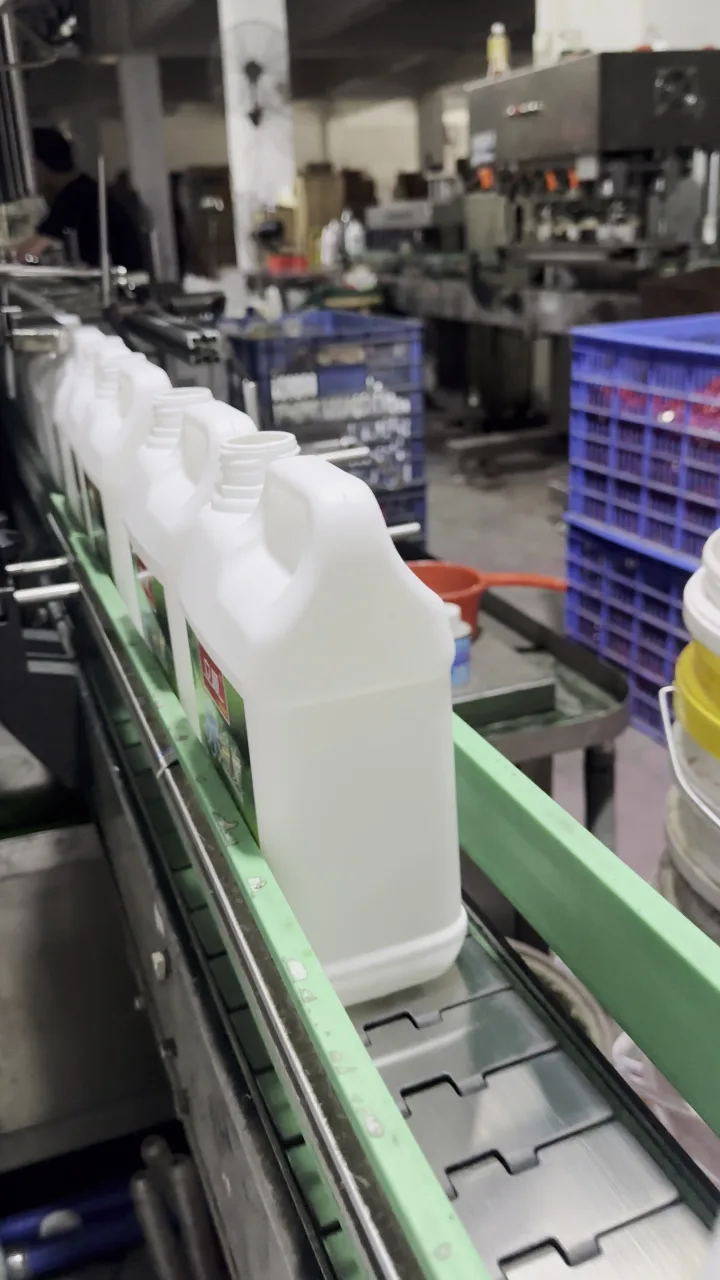
Once the diagnosis clears the fluid, the remaining risk is genuinely the supplier's: one lot that is not the same as the last one. Washer fluid is a simple product, which is exactly why it is easy to buy badly and why a low-cost formulation can separate after weeks in a hot container. A receiving check on the first pallet takes minutes and gives a distributor something far more useful than a price dispute — a comparable record. The photograph below shows finished jugs queuing along a filling line; batch-to-batch consistency starts at this point, long before the carton is printed.
- Appearance in a clear glass: single phase, no layers, floaters, sediment or gel; compare against the retained sample from the previous accepted lot.
- Odour and colour consistent across cartons and across the pallet; a difference between the top and bottom tier is worth investigating before the stock is released.
- Closure and seal: caps seated, no weeping around the neck, no bulged or distorted jugs, and intact outer cartons with a readable batch code.
- Batch code, production date and grade matched to the COA and to the purchase order — a COA with no code tied to the jug is not traceable.
- A retained sample of at least one jug per lot, stored away from direct sun, so any later complaint can be tested against the same batch.
Sealing and storage: why one batch can behave differently
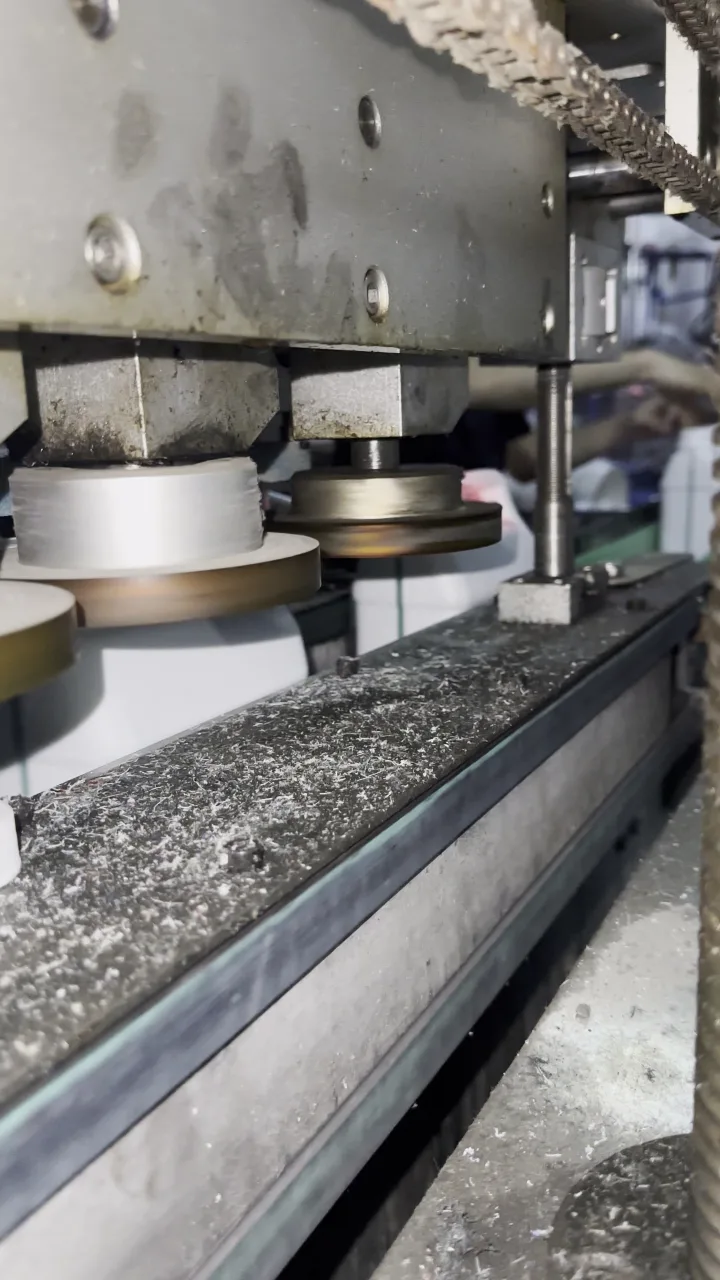
Two identical pallets can age differently. Heat is the main variable: a container that sits in a port yard, a warehouse with no shade, or a retail shelf beside a sunlit window all push a marginal formulation toward separation, and a closure that is not properly seated lets vapour out and contamination in. This is why a distributor should treat the closure and the storage condition as part of the specification rather than as packaging details. The photograph below shows a capping head at work — the step that decides whether the product arrives sealed and stays that way through a long, hot distribution chain.
| Risk in the chain | What the customer later sees | Action at receiving and in storage |
|---|---|---|
| Sustained high temperature in a container or yard | Layers, cloudiness or floaters in the bottle; weaker cleaning | Store off the floor, out of direct sun; check a sample from the hottest pallet position first |
| Closure not fully seated or liner damaged | Weeping at the neck, low fill level, contamination | Inspect caps on a defined sample size; reject leaking units and record the batch code |
| Mixed lots on one pallet | One complaint that cannot be reproduced on another bottle | Keep lots separate, label by batch code and rotate first-in-first-out |
| Dilution done locally with hard water | Mineral haze on glass and blocked nozzles | Specify deionised water for any dilution; never dilute in the reservoir |
| Long shelf time in a warm shop | Odour change, colour drift, softened closures | Agree a shelf-life statement and a rotation rule with the supplier before the first order |
A ten-minute demonstration for dealers and fleet buyers
- 1Prepare two clean glass panels: leave one bare, and wipe a very thin smear of a harmless oil or used-wiper residue across half of the other, then let it dry. Mark the halves so the audience knows which is which.
- 2Spray plain water on both halves and wipe once with a clean cloth. The untreated half clears; the filmed half still beads and smears. This shows the audience that water alone is not the answer.
- 3Spray the washer fluid under evaluation on the filmed half, allow a short dwell, and wipe with a fresh cloth. Photograph before and after under the same light and the same angle.
- 4Repeat with a second reference fluid if a comparison is needed — but keep the cloth, pressure, dwell time and lighting identical, or the demonstration proves nothing.
- 5Finish with the blade check: show a nicked blade and the repeatable streak it produces, so the dealer can explain why a new blade is a separate sale.
Keep the demonstration honest. It shows a visible difference under controlled conditions; it is not a laboratory result, and it should never be turned into a percentage claim on a carton. What it does very effectively is move the conversation from a claim that the fluid is bad to a shared description of what is on the glass, what the fluid lifts, and what needs a blade or a proper decontamination. For a fleet buyer, running the same ten minutes on one vehicle from the yard is usually enough to settle a complaint that has been bouncing between the workshop and the parts counter for weeks.
What to write into the specification and the label
| Specify | Why it matters | Wording that survives a dispute |
|---|---|---|
| Grade matched to destination climate | A 0 °C ready-to-use grade suits frost-free tropical markets; a winter grade is a different product | Freeze grade stated per destination market; confirm the required low-temperature performance before loading |
| Water quality | Hard water leaves mineral haze and scales the nozzle | Deionised or demineralised water; no local dilution unless the water quality is agreed |
| Detergent function described in plain language | Sets an honest expectation for a few seconds of wiping | Lifts fresh road grime, insect residue and light oily film; does not strip cured coatings |
| Single-phase stability after hot storage | Catches the failure that produces a complaint that one batch is different | No layers, sediment or floaters after the agreed storage condition; retained sample per lot |
| Closure, fill and batch coding | Traceability and leak-free arrival | Sealed cap, nominal fill, batch code on jug and carton tied to the COA |
| Label wording and hazard classification | Avoids a claim that cannot be supported at import | All claims, symbols and languages confirmed against destination-market requirements before printing |
Frequently asked questions
| Question | Short answer |
|---|---|
| The driver fitted new blades and it is still blurry — is the fluid defective? | Usually not. New blades scrape the film off briefly, then pick it up again. Decontaminate the glass first and keep a detergent-forward fluid in the reservoir. |
| Can a washer fluid remove a wax or hydrophobic coating? | Not reliably. Those layers are designed to stay on the glass. A dedicated glass decontamination step is the honest answer, and the label should not promise otherwise. |
| Why is night driving worse than daytime? | A thin film scatters point light sources. Oncoming headlights and streetlights reveal a haze that diffuse daylight hides, which is why the complaint often starts after dark. |
| What does a separated or cloudy bottle mean? | Treat it as an incoming-inspection failure. Quarantine the lot, compare with the retained sample, and ask for the batch COA before releasing stock. |
| Should a concentrate be diluted in the washer reservoir? | No. Mix only with deionised water in a clean container at the stated ratio; diluting in the reservoir with tap water reintroduces scale and an unknown freeze grade. |
| What should a distributor include with a claim? | The batch code, a retained sample, a photograph of the glass under the same night-time conditions, the blade inspection result and the spray-pattern check. |
The commercial point
A blurry-windshield complaint looks like a product problem and is usually a diagnosis problem, which makes it one of the cheapest pieces of goodwill a distributor can buy. Teaching a counter the six-step check costs a cloth, a torch and ten minutes; it stops good product being returned, it creates a legitimate blade and glass-cleaning sale, and it gives the workshop a reason to keep ordering from the same supplier. The part that really does belong to the supplier — consistent formulation, a sound closure, a traceable batch code and documentation that matches the jug — is also the part worth checking before the first container ships. Get that right and the rainy-season conversation changes: instead of arguing about whose fault the haze is, the counter asks which grade, which pack size and which label language the next order needs. That is a much better question to be answering.
Request washer fluid grades, TDS and a batch COA
Technical data sheets (TDS) are ready to download for our washer fluid grades, and safety data sheets (MSDS) are available on request. Tell us your destination climate, monthly volume, pack-size mix and whether you need private label, and we will send the grade options, a sample plan for your first container and the batch COA tied to the code on the jug. Visit bolitch.com or email sale@bolitch.com.